

Cash vs Accrual Accounting For Contractors
Selecting an accounting method is one of the most critical structural decisions a construction business will make. While cash accounting offers simplicity and direct visibility into liquidity, accrual accounting provides a far more accurate reflection of long-term operational health by matching revenues directly with the expenses incurred to earn them. Given the prevalence of progress billings, subcontractor payables, and inventory costs in construction, transitioning from cash to accrual (or managing a hybrid model) often becomes mandatory as revenue grows. This guide breaks down the key mechanics of cash vs. accrual accounting for contractors, IRS eligibility rules, and how each method impacts your financial reporting and bottom line.
Understanding Cash vs Accrual Accounting
At its core, the difference between cash and accrual accounting comes down to timing: specifically, when your business officially recognizes income and expenses on its financial statements.
Cash Basis Accounting: Driven by Money Flow
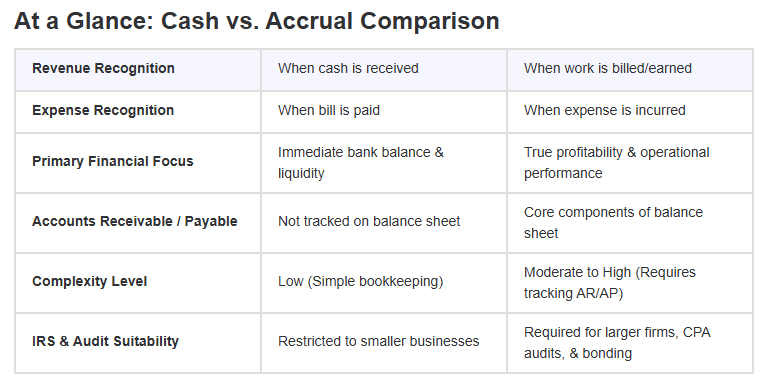
Under cash basis accounting, financial transactions are recorded only when actual money changes hands:
- Revenue is recognized when a client's payment lands in your bank account.
- Expenses are recognized when cash leaves your account to pay a supplier, subcontractor, or bill.
Example: You complete a framing job in October and send a $15,000 invoice. The client pays you in December. Under cash accounting, that $15,000 counts as December revenue—it does not exist on your income statement in October or November.
For small trade contractors or solo operators, cash accounting is attractive because of its simplicity. It gives a direct, real-time picture of how much spendable cash is in your bank account today.
Accrual Basis Accounting: Driven by Activity & Earnings
Under accrual basis accounting, transactions are recorded when they are earned or incurred, regardless of when money actually moves. This method follows the matching principle, pairing project revenues with the exact expenses required to generate them.
- Revenue is recognized as soon as you complete work or issue an invoice (Accounts Receivable).
- Expenses are recognized as soon as you receive a subcontractor bill or order materials (Accounts Payable).
Example: Using the same framing job above, the $15,000 is recognized as October revenue because that is when the work was performed and billed, even though the cash won't arrive until December.
While accrual accounting requires closer tracking of receivables and payables, it delivers a much clearer picture of your company's true profitability and operational health.
Why Construction Makes This Choice Complex
In standard retail or simple service businesses, transactions resolve quickly. Construction projects, however, regularly involve 30- to 90-day payment lags, retainage withholdings, progress billings, and heavy upfront material costs.
Because of these unique project dynamics:
- Cash accounting can make a booming, highly profitable contractor look broke if clients are slow to pay.
- Accrual accounting can make a contractor look flush with profit on paper while their bank account sits dangerously low.
Understanding this gap is essential for choosing which method powers your management decisions, tax strategy, and project estimating.
How Cash Basis Accounting Obscures True Job Profitability
Job costing is the absolute core of the trades. Knowing precisely what each project earns and costs is essential, yet cash basis tracking makes this incredibly difficult for any work extending past a few weeks.
Several key areas frequently become distorted:
- Mismatched Cost of Goods Sold (COGS) timing. When materials are purchased in one month but installed in another, they are logged in the wrong period, causing gross margins to fluctuate without any operational cause.
- Labor and burden misalignment. Payroll is processed weekly, but the corresponding client billing might lag by three weeks, falsely making successful jobs appear unprofitable.
- Phantom profit months. A substantial customer payment is counted entirely as revenue upon arrival, falsely inflating profitability during months when actual field production was slow.
- Phantom loss months. Prepaying for a major material order or covering a prevailing wage payroll run can suddenly cause an otherwise strong month to show a deficit.
- Fleet and equipment misallocation. Cash basis accounts for large purchases as a massive single-month expense rather than distributing the depreciation across the entire multi-year lifespan of the asset.
How Accrual Accounting Handles Retainage, Deposits, and Progress Billing
Contract structure is the reason accrual matters so much in construction. Very little about your revenue arrives cleanly.
Retainage is the clearest example. A general contractor withholds 5 or 10 percent until closeout. You earned that money. Cash basis says it does not exist until it lands, sometimes a year later. Accrual accounting puts it on the balance sheet as retainage receivable, so your earned revenue and your AR aging both tell the truth.
Customer deposits work in the opposite direction. Cash arrives before the work happens. Accrual treatment records the deposit as a liability, because you owe the customer either work or a refund. Recognizing it as revenue on day one inflates your month and sets up an ugly correction later. Our guide on how to account for work deposits in construction walks through the mechanics in more detail.
Progress billing needs the same discipline. Accrual accounting lets you compare what you billed against what you actually earned. That comparison produces the two numbers every growing contractor should watch.
Overbilling means you have billed ahead of production, which feels good but borrows cash from future months. Underbilling means you have performed work you have not invoiced, which is money sitting in the field instead of your account. A percentage of completion approach and a simple work in progress schedule surface both.
Lien releases, change orders, and closeout timing all flow through the same logic. Accrual books tie your paperwork to your financials instead of leaving the two on separate tracks.
Indicators That Your Construction Company Has Outgrown Cash Accounting
Contractors rarely transition to a new accounting methodology for theoretical reasons; rather, they make the shift when an operational blind spot becomes too costly.
Key warning signs include:
- Wild monthly profit fluctuations despite steady activity on-site.
- An inability to identify your most profitable project types without manually reconstructing financial metrics.
- External demands for accrual-based statements or a WIP schedule from banking institutions, bonding agents, or surety underwriters.
- Losing visibility on outstanding funds due to substantial, untracked retainage balances.
- Relying on intuition rather than unreliable margin reports when pricing new bids.
- Company ownership spending valuable time addressing routine bookkeeping queries rather than managing strategic operations.
Experiencing even two of these symptoms typically indicates that your financial infrastructure has been eclipsed by your company's growth.
The transition is generally smoother than anticipated. It begins by establishing a clean chart of accounts focused on job costing. From there, you implement structured Accounts Payable and Accounts Receivable workflows, retainage tracking, a dedicated account for deposit liabilities, and routine monthly work-in-progress (WIP)e valuations. While it requires an initial investment of effort, it functions as a one-time setup project rather than an ongoing operational drag.
Building a Financial Foundation to Match Your Growth
When wild profit swings, missing retainage tracking, and guesswork pricing begin to stall your momentum, holding on to cash-basis bookkeeping does more harm than good. Transitioning to accrual accounting provides the clear job costing, WIP visibility, and financial credibility you need to secure bigger bonds, protect your margins, and scale with confidence.
Ready to gain true control over your project profitability? The team at First Steps Financial specializes in helping contractors upgrade their financial infrastructure with seamless transitions to accrual accounting, clean job costing, and reliable WIP reporting. Our fractional bookkeeping services handle the close, the reconciliations, and the AP and AR work that accrual reporting depends on. Contact us today to build a financial foundation as strong as your builds.
Frequently Asked Questions
Can we report on accrual and still watch cash closely?
Yes, and you should do both. Accrual reporting shows you profitability by job and by period. A rolling cash flow forecast shows you whether payroll will clear in time. Most well-run contracting businesses review accrual financials monthly and cash weekly. The two answer different questions.
Does QuickBooks Online support accrual reporting for contractors?
It does. QuickBooks Online can produce both cash and accrual views from the same data set. The accuracy depends on the setup, not the software. Job level tracking, item lists, deposit liability accounts, and clean AP entry all matter.
Do lenders and surety underwriters care which accounting method we use?
Often, yes. Sureties commonly want accrual financials plus a WIP schedule before increasing bonding capacity. Lenders reviewing a line of credit look for the same clarity. Cash basis statements make it harder for an underwriter to assess your backlog and your true margin, which can limit what you qualify for.
Our Latest Insight