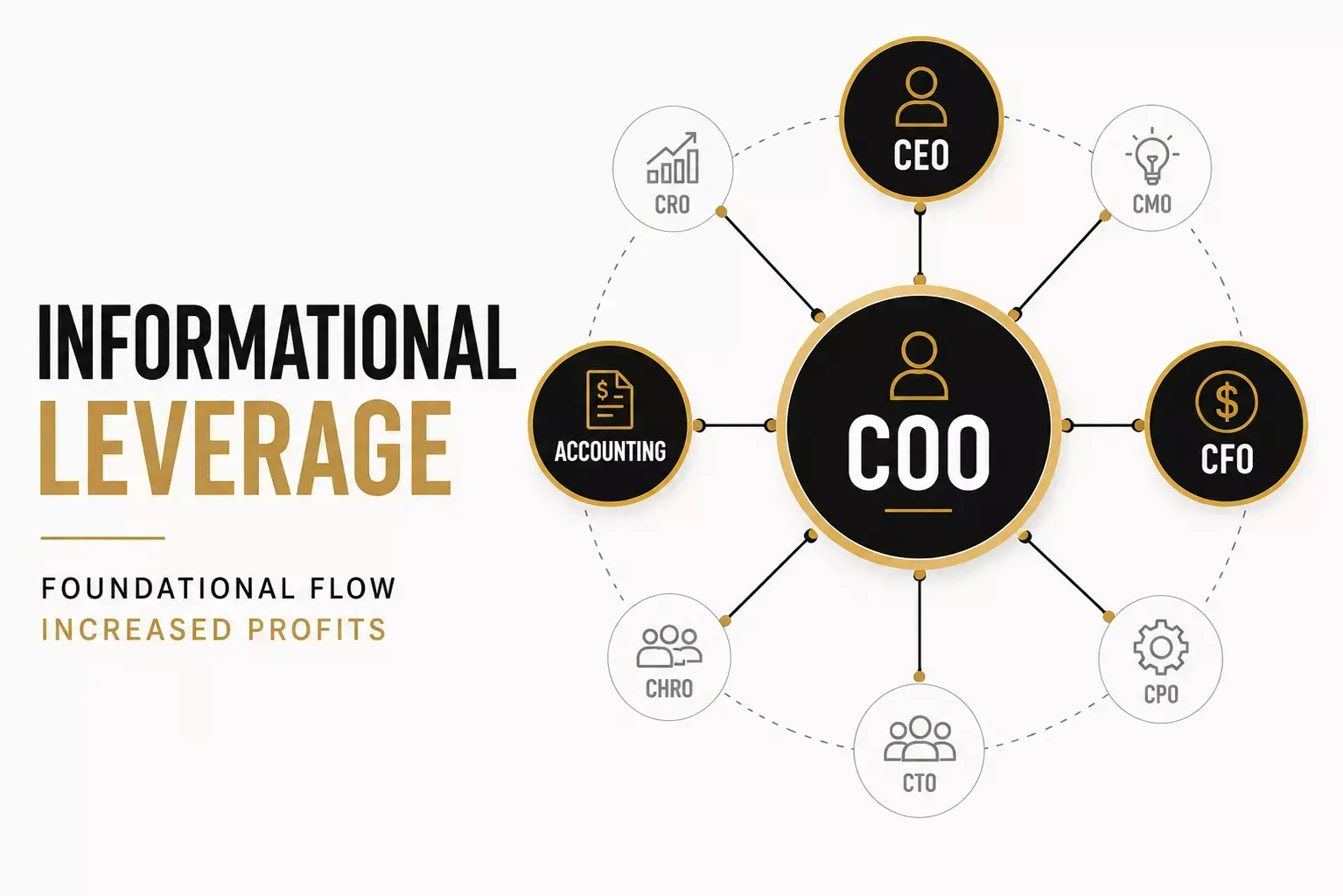

Fixing It: How to Build the COO-Accounting Relationship Your Business Is Missing
If Article 3 felt a little too familiar, your first instinct may be to call a meeting. You tell Operations and Accounting they need to communicate better. That will not fix it. The five warning signs were never personality problems. They were signs that your accounting systems and routines were never intentionally built around how these two functions work together.
People cannot follow a structure that does not exist. Accounting cannot inform decisions they do not know are being considered. Your COO cannot use financial information they cannot access in time.
The fix is not complicated. That does not mean it happens naturally. Most of what you need to build will feel almost obvious. Recurring conversations. Clear handoffs. Shared definitions. Access to the right information.
This is not glamorous work. That is probably one reason it gets overlooked.
For the first few months, you may have to follow up constantly. People will forget. Meetings will get moved. Someone will make a decision and skip the handoff. Then something starts to change. The follow-up becomes unnecessary. Information moves without you. Problems get caught earlier.
Eventually the results look effortless from the outside. They were not. You built the relationship that made them possible.
Part 4 of a 5-part series on the COO-Accounting relationship

Why Your Accounting Systems Should Inform Decisions, Not Just Record Them
Article 3 showed what happens when Accounting learns about the business by reading transactions after they occur. A new vendor appears as a line item. A raise shows up in payroll. A project overrun appears in a variance report.
At that point, Accounting is not informing the business. It is documenting what the business already decided. That is the first pattern to break.
Make the Monthly Close Predictable
Start with your monthly close. Ask Accounting what a realistic close date actually is. Then publish it.
It does not need to be the fifth business day because another company closes that quickly. If your team consistently closes on the tenth business day, start there. Predictability matters more than an impressive deadline.
Your COO can plan around a known date. They cannot plan around "sometime next week."
Then work backward and forward from that date. What does Accounting need from Operations before close? When should they receive it?
What does the COO need once close is complete? A consistent close is also one of the clearest signs you are ready for controller-level oversight.
Stop Letting Transactions Become Notifications
Operations needs a consistent way to tell Accounting what is changing as it happens.
New hires, raises, vendor agreements, project starts and stops, pricing changes, and capital spending should not arrive first as transactions.
Accounting should not discover a hiring decision when the employee appears in payroll. It should not learn about a vendor agreement when the invoice lands.
The transaction should confirm information Accounting already had.
Give the Relationship a Recurring Rhythm
The COO and Accounting need a recurring monthly working conversation after close. This is not the CFO's financial review.
The CFO may be looking at the forecast, long-term strategy, or capital planning. The COO and Accounting are asking a different set of questions.
What happened last month that we expected and what did not? What is already committed next month and what changed operationally that has not shown up financially yet?
Then add a much shorter conversation in between. Fifteen minutes once a week can be enough. The COO brings what changed in the business. Accounting brings what is changing in the numbers.
Capacity Is Usually the Hidden Cost
Accounting often spends days chasing receipts and reconstructing decisions Operations already made. Your employees feel overloaded because they are overloaded.
A meaningful portion of that workload is non-value-added effort created by poor information flow. They spend capacity re-creating context instead of analyzing, planning, and supporting better decisions.
Owners often reach the wrong conclusion here. The team feels maxed out, so the instinct is to hire someone. Adding headcount does not fix a broken flow of information. It can simply place another person inside the same inefficient structure.
Fix the handoff first. Then decide whether you truly need more people.
More Reports in Your Accounting Systems Do Not Mean More Visibility
Growing businesses tend to create more reports as they grow. That can create the appearance of visibility without actually creating it.
You can have twenty reports and still leave your COO without the answer they need on Tuesday afternoon.
Start With Decisions, Not Reports
What decisions does your COO make repeatedly? Hiring. Vendor commitments. Project changes. Pricing. Resource allocation. Capital spending.
Then ask what information makes those decisions better. For every important number, your team should be able to answer five questions:
- What does this number actually mean?
- Where does it come from?
- Who owns it?
- When is it available?
- What decision are we using it to support?
That last question matters more than most businesses realize. If nobody can explain what decision a report supports, ask why your team spends time producing it. Your tools should serve those decisions, which is why the accounting tech stack you choose deserves the same scrutiny.
Make Sure Everyone Means the Same Thing
This is where you solve one of the quieter problems from earlier in the series. Two teams use the same word and mean two different things.
Ask Operations and Accounting to define labor cost, margin, committed spend, overhead, and cash available.
You may discover people have sat in the same meetings for months while discussing different numbers. Both walk away believing they agreed.
The disagreement surfaces later when the decision underperforms.
Write the definitions down. You do not need a complicated data dictionary. You need enough shared language that margin means one thing to everyone.
Pay Attention to the Workarounds
If someone in Operations built their own spreadsheet, do not immediately delete it. Study it.
The shadow ledger from Article 3 exists because someone needed visibility badly enough to build it themselves. Yes, it may duplicate work. It is also a clue about something the current structure is not providing.
Ask what they are trying to see and what decisions they make from it. Then bring Accounting into the conversation.
The goal is not to punish the workaround or simply replace the spreadsheet. The goal is to understand what it solved and build the useful parts back into the business.
Your employees usually find the gaps first. The COO makes sure those discoveries do not stay trapped inside one person's file.
Building Accounting Systems: Your COO Cannot Coordinate What They Cannot See
Article 1 described the COO as the hub of the wheel. That role is not limited to moving information between the spokes. The COO should also learn from what happens across them.
That requires visibility.
Your COO should not file a request to see current spend, margin, cash, or project position. If the information is necessary to coordinate the business, access should already exist.
The exact tool matters less than the visibility. It could be a dashboard, a report, or a shared file. What matters is timing. Tracking project profitability is a good example, because margin erosion rarely announces itself.
Without that visibility, lessons stay local. One employee keeps maintaining the spreadsheet. Another department builds its own workaround.
Someone else solves the same problem six months later.
Small Questions Predict Expensive Problems
When getting information is difficult, people eventually stop asking for it. And that is exactly what you do not want.
- Why did overtime increase again?
- Why is margin dropping on this project?
- Is this customer becoming more expensive to serve?
- Why did this vendor expense change?
- Do we need another employee, or did workload spike temporarily?
Those questions do not feel urgent. Then three months later the pattern has become expensive.
Accounting often sees the financial signal first. Operations understands what is causing it. The COO connects the two. That is how a number stops being something you report and starts becoming something you use.
Different Perspectives Are the Advantage
Even when the structure works, Operations and Accounting will see the business differently. They should.
Operations is responsible for movement. Customers are waiting and projects have deadlines. Accounting knows what the business has actually experienced financially.
Neither perspective is complete on its own. The advantage comes from putting them together.
Your COO may need an answer today while the final number arrives Thursday. Accounting can share what the numbers support now and explain what is still unknown. The COO adds operational context and decides whether to move or wait.
Accounting may see a cost that Operations sees as an investment. Those are not problems to eliminate. They are questions worth investigating.
A strong relationship does not make the two functions think alike. It makes their differences useful.
How to Build Accounting Systems That Hold Up Under Pressure
Structure is easy to design and hard to protect. The build survives busy months only when someone keeps reinforcing it.
The Owner Has a Role in Making This Stick
There is one part of this the owner cannot delegate. You have to reinforce it.
You are the person who makes it clear that Accounting contributes before decisions are made. You give the COO authority to coordinate information across departments. You decide the recurring conversation survives a busy quarter.
You also have to resist becoming the messenger between the two functions.
If you carry every message back and forth, you have not built the relationship. You have made yourself the relationship. That works while the company is small. Eventually it makes you another bottleneck.
Build It in Layers, Not All at Once
In the first month, establish the rhythm. Publish the close date. Create the monthly conversation and the shorter weekly touchpoint. Agree on which operational decisions must reach Accounting early.
Then clean up the language. Pick the financial terms both teams use most and agree on what they mean.
Next, look at the information your COO actually uses. Where does it come from? How quickly is it available?
Then set the decision rules. When is the best available number enough? When does the business wait for the verified one?
None of this requires rebuilding your company. The people are already in the building. The data already exists.
Where the Build Usually Falls Apart
The first failure is inconsistency. The monthly meeting gets skipped. The close date slips and nobody resets it. The owner gets frustrated and steps back into the middle.
The second failure is letting the monthly conversation become another status meeting. The purpose is not to recap last month. The purpose is to connect financial results with operational reality.
The third failure is leaving expectations unchanged. If Accounting is only rewarded for closing quickly, that is what they will protect. If Operations is only rewarded for speed, collaboration disappears under pressure.
People protect what the business tells them matters.
What You Are Building in Your Accounting Systems
You do not need your accountant to become an operator, or your COO to become an accountant.
You need Accounting to understand what the COO is trying to accomplish and the COO to understand enough financial context to turn information into a decision.
Many growing service businesses reach this point without the internal bench to build it. First Steps Financial has been the fully remote fractional accounting department for service businesses since 2012. Our fractional bookkeeping work covers the close, reconciliations, and AP/AR that make a predictable rhythm possible. Our fractional controller service adds reporting, KPI dashboards, and forecasting. Your COO gets the analysis before the decision, not after it.
Build Your Accounting Systems: Start With Two Questions Tomorrow
If you want to know where to begin with your accounting systems, ask Accounting one question. What decision did we make recently that you wish you had known about before it happened?
Then ask your COO one question. What financial question did you recently need answered that was harder to get than it should have been?
Put those two answers next to each other. The space between them is where you start.
You do not have to close that gap alone. Talk with us about building the accounting systems your COO needs to make faster, better-informed decisions.
Frequently Asked Questions
Do we need a full-time accounting manager to make this work?
Not always. An accounting manager helps once transaction volume and staff size grow. Many service businesses between $1M and $25M get the same result from a fractional team. What matters is that someone owns the close calendar, the definitions, and the handoffs.
Can outsourced bookkeeping services support a rhythm like this?
Yes, when the engagement is built around communication and not just data entry. Good outsourced bookkeeping includes a published close date and a standing conversation. Ask any provider how they handle mid-month changes before you sign.
What accounting principles should both teams understand?
Operations does not need technical training. They need a working grasp of accrual timing, cost classification, and how commitments differ from cash. Shared accounting principles keep both teams reading the same statement the same way.
How is this different from hiring virtual CPA services?
Virtual CPA services often focus on compliance and periodic review. Ongoing accounting and bookkeeping services focus on the daily flow of information your COO depends on. Most growing businesses need the operating rhythm first.
How often should we revisit this structure?
Review it once a year and after any major change. New service lines, acquisitions, and headcount jumps all shift what the COO needs to see. The rhythm that worked at $3M often strains at $10M.
Marc Chianese provides dedicated accounting support at First Steps Financial. A proud U.S. Navy veteran, Marc discovered his passion for numbers during his service in Okinawa, Japan, where he earned his bachelor’s degree in accounting. His transition from nine years of submarine hunting to the world of finance reflects his discipline, precision, and commitment to excellence."
Shirah Huff continues to be an integral partner to businesses that are generating revenue but taking home far less profit than they should. Her comprehensive approach combines how the brain actually works with practical, tactical tools to improve both business profitability and the performance of the people within it. Her passion is creating environments where people and businesses can achieve their highest potential, which she does every day through fractional leadership, executive coaching, and her proprietary program, The Kinetic Method™.
Our Latest Insight