
When Should I Add a Controller to My Accounting Team: The Financial Controller Readiness Checklist
As your service business grows, there comes a point where basic bookkeeping no longer gives you the full financial picture you need. Knowing when to bring in a financial controller can be the difference between scaling confidently and flying blind.
What a Financial Controller Actually Does
A financial controller is essentially your company's chief accountant. They oversee accounting operations, ensure your financial statements are accurate, manage budgets, reconcile accounts, and translate complex financial data into clear insights for leadership.
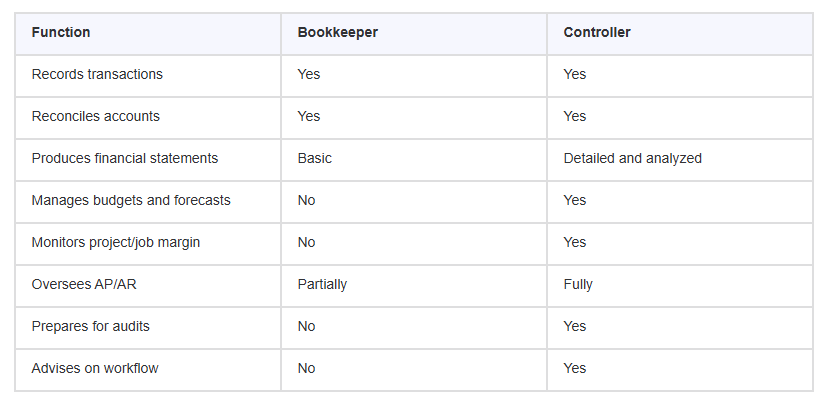
Unlike a bookkeeper who records transactions, a controller interprets what those numbers mean for your business. They also oversee accounts payable and receivable, coordinate audits, and set financial performance benchmarks.
For service businesses specifically, this means someone who understands utilization rates, WIP for unbilled hours, project profitability, and realization rates. These are the levers that actually move the needle in a people-driven business.
The Financial Controller Readiness Checklist
How do you know you're ready? Run through these signs:
- Your revenue has crossed $1M and is growing fast. More revenue means more complexity. A bookkeeper handles the past. A controller helps you manage the present and prepare for the future.
- Your financial reports feel reactive, not proactive. If you're only looking at numbers after decisions are already made, that's a gap a controller fills.
- Cash flow surprises keep happening. Unexpected shortfalls often signal that AR management, billing cycles, and WIP tracking aren't being monitored closely enough.
- You're losing visibility into project profitability. If you can't tell which clients or projects are making you money, you need controller-level oversight, not just a P&L.
- You're preparing for growth, a credit line, or an audit. Lenders and auditors want clean, well-structured financials. A controller makes sure you're ready.
- Month-end close takes too long or keeps having errors. This is a process and oversight problem, and it's exactly what a controller is built to solve.
- You are still doing financial reviews. If you, or a partner, are spending hours reconciling reports or questioning numbers, your time is not being optimized.
Financial Controller vs. Bookkeeper: Understanding the Gap
Many growing service businesses assume that hiring a bookkeeper is enough. Here's where the roles diverge:
The Cost of Waiting Too Long
Waiting until something breaks is the most expensive approach. When controller-level oversight is missing, businesses tend to overbill or underbill, miss collection windows on AR, misjudge capacity, take on unprofitable work, and end a strong-revenue year with weak cash on hand.
For contractors, this can look like poor progress billing or retainage that never gets collected. For consulting and engineering firms, it shows up as WIP that sits unbilled for months. The financial damage compounds quietly until it becomes a crisis.
Achieving Financial Maturity Without the Overhead
You don't need a full-time controller to gain the executive-level oversight your business deserves. Fractional accounting services offer a practical, scalable alternative that bridges the gap between basic bookkeeping and costly in-house leadership.
First Steps Financial functions as your comprehensive, fractional accounting department, integrating bookkeeping, controller-level analysis, and ongoing support into a single, cohesive team. For service businesses generating between $1M and $25M in revenue, this model delivers the rigorous financial insight of a seasoned controller without the significant expense of a full-time executive hire.
If you identified with three or more points on our readiness checklist, it’s time to elevate your financial strategy. Your business has matured, and it deserves a foundation as robust as the services you deliver. Reach out to First Steps Financial today to explore how our fractional model ensures you get the precise level of expertise your growth stage demands.
FAQs
What is a controller in finance?
A financial controller is a senior-level accounting professional who oversees a company's daily accounting operations, financial reporting, budgeting, and internal controls. They ensure financial statements are accurate and compliant. They also translate financial data into insights that help leadership make smarter decisions.
Is a controller the same as a CFO?
No. A controller focuses on the accuracy and integrity of financial records and reporting. A CFO operates at a higher strategic level, focusing on long-term financial planning, investor relations, and capital structure. In many growing service businesses, a controller is employed before a CFO becomes necessary.
Do I need a full-time controller, or can I outsource that role?
For most service businesses under $25M in revenue, a full-time controller isn't necessary yet. Fractional controller services provide the same level of oversight and reporting at a fraction of the cost. This is especially practical when you need more than bookkeeping but aren't ready to add a full executive salary.
What's the difference between fractional accounting and outsourced bookkeeping?
Outsourced bookkeeping typically covers recording transactions and reconciling accounts. Fractional accounting services go deeper, including controller-level financial reporting, budgeting, cash flow analysis, and strategic financial support. Think of it as getting a full accounting department rather than just someone to keep your books clean.
How does a controller help with billing and collections in a service business?
A controller monitors AR aging, identifies slow-paying clients, and puts processes in place to tighten your billing cycle. For project-based businesses, this includes tracking WIP (work-in-progress) to ensure unbilled hours get invoiced promptly, and for contractors, it includes managing progress billing and retainage to protect cash flow across long-duration jobs.
Our Latest Insight