

The Missing Relationship That Is Stifling Your Growth
"Accounting is a stick in the mud." "I'm not really sure what a COO does all day." "The CFO just plays around with their little Excel sheets." You have probably heard one of those lines. You may have thought one yourself. They sound like harmless office humor. They actually point to something expensive. In most growing service businesses, nobody has ever defined how operations and accounting work together. The people who produce your financial reports sit outside the very decisions those reports are meant to inform. That gap costs you every single month, quietly, in profit that should have been there.
Part 1 of a 5-part series on the COO and Accounting relationship
Why Your Accounting Team Gets Treated Like the Cleanup Crew
Now ask yourself a different question. Do you think that way about your attorney? Probably not. Consider how your business actually uses one.
You do not have an attorney on staff. You call when something has already gone sideways. A contract dispute. A compliance question. A hire that went wrong. They arrive after the decision and after the damage. They were never part of the conversation.
Look at where the structure breaks down. Accounting does not carry a C-suite title. It does not sit at the strategy table by default. In most org charts it reports up through the CFO. That sounds logical until you look closer. It collapses two very different functions into one chain of command. Two things happen as a result. Important information gets filtered on its way through. The relationship between accounting and operations stays completely undefined.
The rest is predictable. Accounting gets treated like a professional service. You bring them in when you need something. You loop them in after the decision is already made. Then they push back and say it is not in the budget. Now they wear the label: the department that only knows how to say no.
Here is what that narrative gets wrong. The "no" almost always comes from the relationship, not from the accounting itself. There is no consistent communication. No shared operating rhythm. No proactive loop with the people making operational calls. The only tool left is the brake. Build the relationship differently and the answer changes.
Three Time Horizons Behind Your Financial Reports
We all know the titles. The responsibilities are more debatable. Let us level set on what each role actually does day to day. They are not doing the same job, and that difference is the whole point.
The CFO is future focused. They think in years, not weeks. Strategy, forecasting, capital allocation, where the business needs to be in three to five years. Their value is visionary. They ask what is possible and build the financial case for it.
The COO is present focused. They live in execution. Today's hiring decisions. This quarter's vendor contracts. This week's operational cost picture. They coordinate the CFO, the accountants, and every other function at the same time. What they need is current and accurate data, not projections or models. That makes the COO's dependency on accounting different in kind from the CFO's.
Accounting is past focused. They hold the documented record of what actually happened. Where money went. What was spent, what margins really looked like, and what the cash position is today. That record is not a limitation. It is the foundation everything else is built on. Without accurate financial reports, the CFO is forecasting from fiction and the COO is executing blind.
Consider a simple example. Your business takes out a loan. Accounting surfaces the current cash position, the AR balance, and the documentation the bank needs. The COO defines how to maximize what that capital makes possible operationally. The CFO maps the long-term strategy for deploying the funds. Three different functions. One coordinated outcome.
That coordination never happens by accident. It requires a defined relationship between the COO, the CFO, and accounting. It also requires the right level of talent producing the numbers, which is often the trigger for adding a controller to your accounting team.
The Wheel, the Hub, and the Spoke Nobody Connected
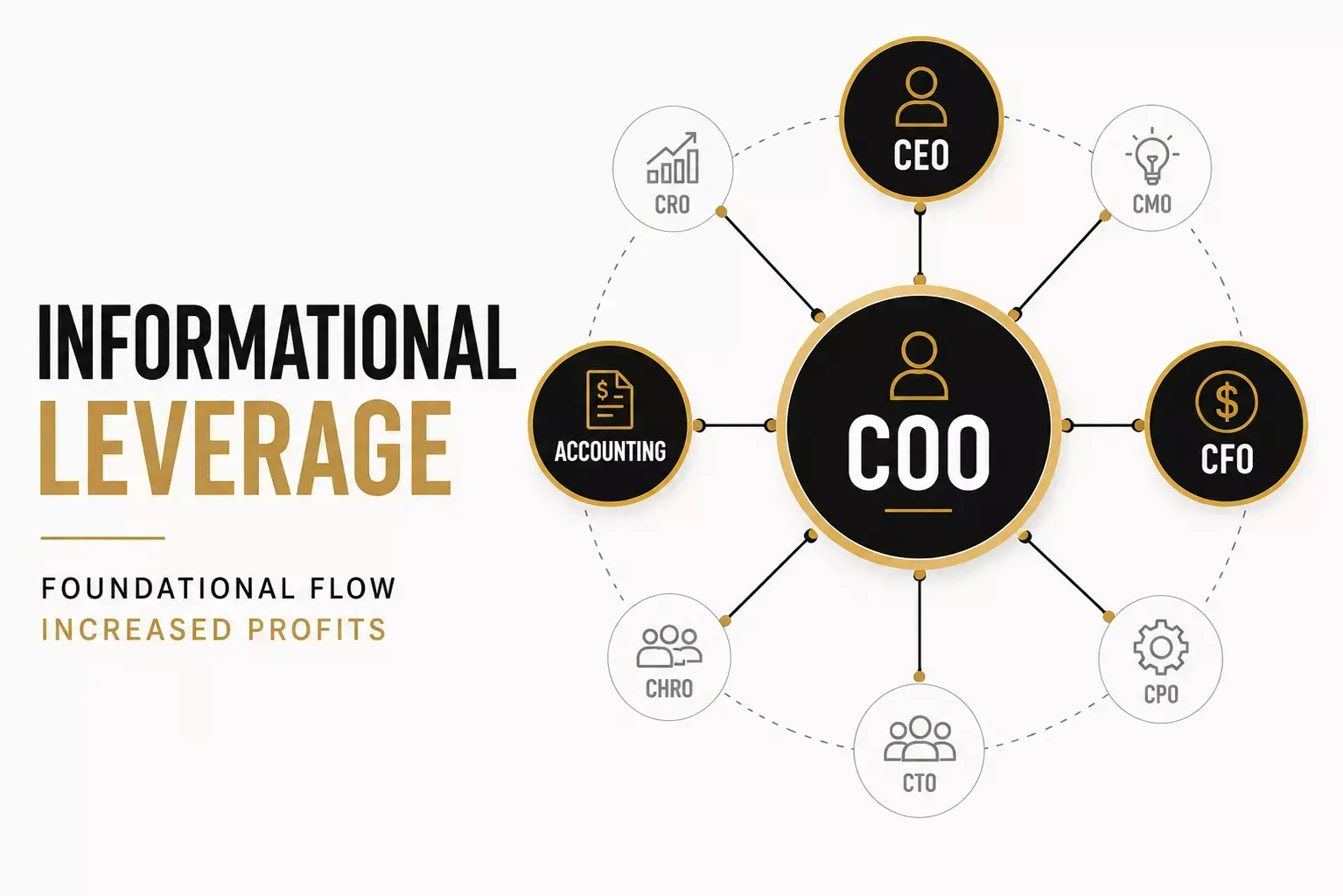
Picture a wheel. The spokes are your business functions. Sales, marketing, finance, accounting, HR, operations. Each has a role. Each is essential. When all of them work, the wheel moves.
The hub is the COO. The hub does not own every function. Its job is to connect the spokes to each other and distribute pressure across all of them. When one spoke weakens, the hub absorbs the load and stabilizes the wheel while repairs happen. A wheel can still roll with a weakened spoke. When the hub fails, spoke strength stops mattering. The wheel stops.
This is why the COO's relationship with accounting is unlike any other. Picture a project that hits an interruption and gets paused. If the hub is working, that pause travels. Accounting flags that spend is still going out the door. The COO redistributes the freed-up capacity and funding to other active work. The CFO updates the strategy to reflect the new picture.
What Late Financial Reports Actually Cost You
A business can have a brilliant financial strategy and still struggle operationally. When this working relationship stays undefined, the costs stack up quietly.
- Decisions get made blind. The financial picture that should inform a choice arrives after the choice is made.
- Accounting spends its time catching up. The team reconstructs what happened instead of shaping what comes next.
- Teams build workarounds. Operations creates its own spreadsheets to see what accounting could have shown in real time.
- Margins bleed. Money disappears in ways nobody can fully explain.
- A blame culture sets in. Missed numbers become someone's fault instead of a signal. Accounting blames operations for moving without them. Operations blames accounting and the CFO for pulling in different directions. Trust erodes on all sides.
None of this looks like a dramatic failure. The business pays for it consistently instead. It is a slow, expensive leak. It surfaces as budget surprises, strained vendor relationships, and opportunities that never make it onto a report. Cash tightens even when revenue looks fine, which is often a sign that accounts receivable aging has drifted well past healthy benchmarks. The business that should get more efficient as it grows gets more reactive instead. The tail starts wagging the dog.
So here is the question. In your business right now, when does your COO, or whoever plays that role, actually talk to accounting? Not about a specific approval. Not to chase a transaction. Before the decision, not after it. A real conversation. If you had to think about it, that is already an answer.
Start With One Conversation Before the Next Decision
You do not need a reorganization to fix this in your financial reports. You need one recurring conversation that happens before decisions, not after them. Pick the next operational call on your calendar. A hire, a vendor renewal, a piece of equipment, a project you are considering pausing. Then ask your accounting team what the numbers already say about it. Their answer will tell you a great deal about how much visibility you have been operating without.
If that conversation is hard to have because the numbers are not ready when you need them, the relationship is not the only thing that needs attention. Let's talk about building financial reports your operations team can actually run on.
Frequently Asked Questions
We do not have a COO. Who owns this relationship?
Someone already plays the hub role, even without the title. It is often the owner, an operations director, or a general manager. Name that person out loud and give them a standing line to your accounting manager. The title matters far less than the defined rhythm. Problems start when everyone assumes someone else is carrying it
.
How often should operations and accounting actually meet?
Monthly at minimum, tied to your close calendar. Weekly works better for businesses with active projects or crews in the field. Keep the meeting short and focused on decisions ahead, not variances behind. A fifteen minute standing call beats a ninety minute quarterly review.
Can outsourced bookkeeping services really support this kind of relationship?
Yes, and often better than a part-time internal hire. Outsourced bookkeeping gives you a team with defined deliverables and a fixed close calendar. That structure is what makes proactive communication possible. Ask any prospective partner how they handle mid-month questions before you sign anything.
Marc Chianese provides dedicated accounting support at First Steps Financial. A proud U.S. Navy veteran, Marc discovered his passion for numbers during his service in Okinawa, Japan, where he earned his bachelor’s degree in accounting. His transition from nine years of submarine hunting to the world of finance reflects his discipline, precision, and commitment to excellence.
Shirah Huff continues to be an integral partner to businesses that are generating revenue but taking home far less profit than they should. Her comprehensive approach combines how the brain actually works with practical, tactical tools to improve both business profitability and the performance of the people within it. Her passion is creating environments where people and businesses can achieve their highest potential, which she does every day through fractional leadership, executive coaching, and her proprietary program, The Kinetic Method™.
Our Latest Insight