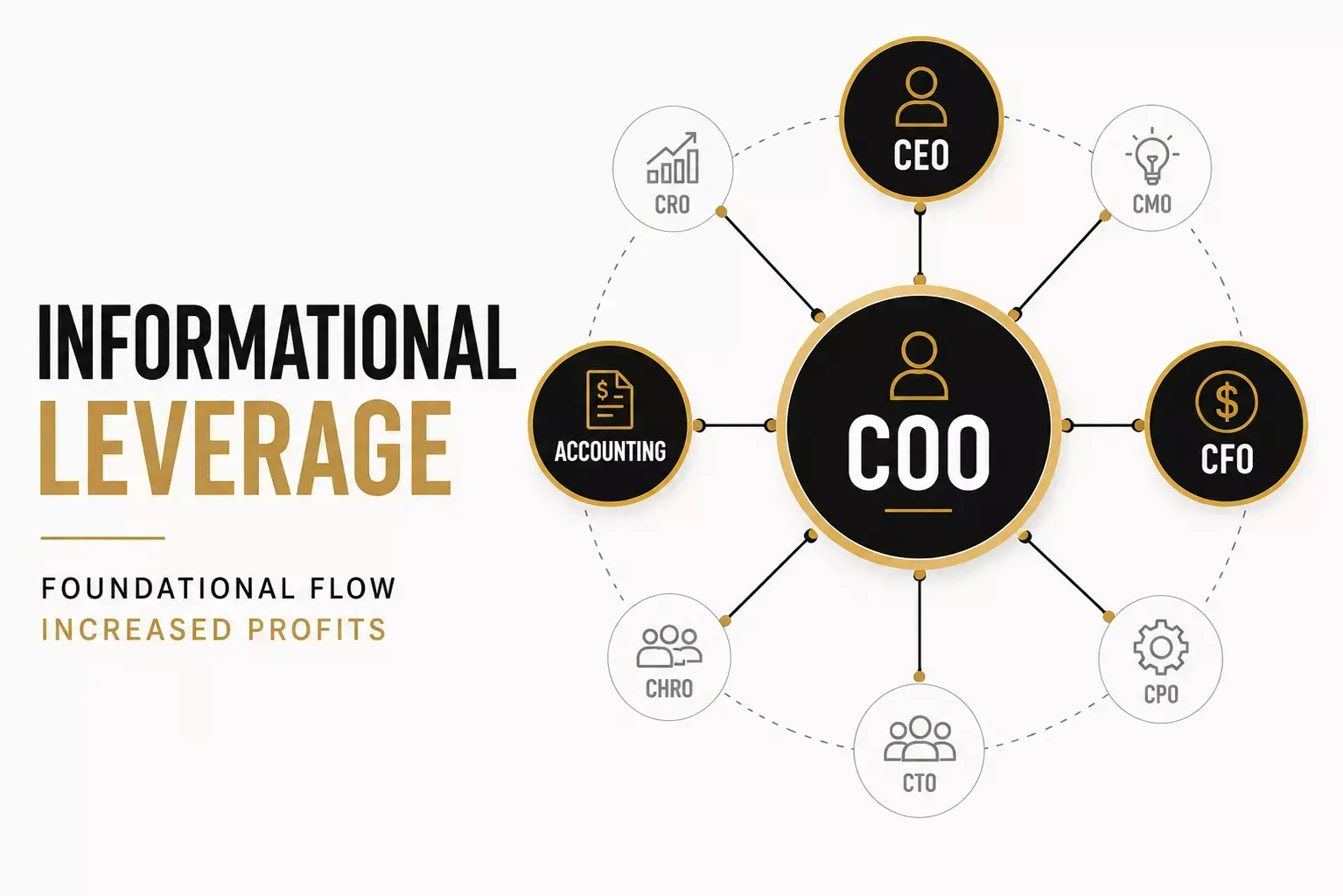

What a Growth-Focused COO-Accounting Relationship Looks Like
Article 1 ended with a question. When does your COO actually talk to Accounting before a decision gets made? How long did it take you to answer? Immediately? Minutes? Maybe you could not think of a single example. Bills get paid, projects keep moving, and financial reports show up. Nothing feels obviously broken, so you conclude everything is fine.
If that question made you uncomfortable, you are not alone.
Here is the part that keeps this problem alive. You only know what good looks like based on what you have already lived through. Most owners have never worked inside a business where Operations and Accounting were intentionally built to function together. So they measure their company against their own status quo.
This article gives you a different reference point. You will see what the relationship looks like day to day, what rhythm it runs on, and five things you can check this week. None of it requires scrapping what you have built. The people are already in the building. The data already exists. What changes is how the pieces are arranged, and how much leverage you get out of the company you have right now.
Part 2 of a 5-part series on the COO-Accounting relationship

Why Your Financial Reports Run on the Wrong Clock
Your CFO and your COO do not run on the same clock. Most businesses only wind one of them.
The CFO works on a quarterly rhythm, because strategy moves in quarters. Board conversations, capital planning, forecast revisions. A quarterly close package serves that horizon well.
Here is what results-focused work actually looks like:
- A monthly close that lands on a published, predictable date. Not "sometime after the 20th." Predictability matters more than speed here. Your COO can plan around slow. Nobody can plan around unknown. A close date that keeps slipping is one of the clearest signs it is time to add a controller to your accounting team.
- A standing monthly COO-Accounting working session, separate from the CFO's financial review. Different meeting, different agenda, different questions. What happened last month, and what is planned for the next one.
- A short weekly signal, directed by the COO. Cash position, committed spend, anything that moved unexpectedly. Fifteen minutes, not a report package. The COO brings the changes that occurred and what they are likely to do downstream. Accounting brings the data behind them. Accounting also flags what should be celebrated, what needs investigating, what seasonality is coming, and what patterns are forming.
Trust, Self-Service, and the Cost of the Conversation That Never Happened
There are two failure directions here. Both are symptoms of the same missing structure.
The COO is uninformed. Every question about spend, margin, or cash requires a request, a queue, and a turnaround. Eventually the COO stops asking the small questions. The cost of asking exceeds the value of the answer. Small questions are exactly the ones that catch problems early. No role in the company needs more visibility than this one. Data from every function, the financials including the numbers that do not get shared out, and the strategy behind both.
Accounting is uninvolved. Receipts, coding, approvals, context on a vendor payment nobody documented. Accounting spends the first ten days of every month reconstructing what Operations already knew in real time. They arrive after the conversation is over. Accounting should be positioned to inform a decision rather than receive one. The difference is usually who was in the room at the start.
What replaces both is standing access plus shared definitions.
The COO gets standing visibility into an agreed set of numbers without filing a request. Dashboard, saved report, shared file, whatever your stack supports. The mechanism matters far less than the permission, because the COO is expected to act on what they see. Much of the accounting tech stack we rely on exists to make that access routine rather than requested.
Operations feeds Accounting on a defined rhythm rather than on demand. New vendor contracts, headcount changes, and project details flow to Accounting when they happen. Not when Accounting notices the transaction.
This is exactly where expensive decisions are either prevented or quietly created.
Making Financial Reports Predictive Instead of Reactive
Reactive accounting answers one question. What happened? A built relationship lets Accounting answer a more useful one. What is about to happen, based on what already has?
Accounting also prescribes how the information should be used: act or inform. Some leaders treat every incoming number as a signal to act. Often the real value of the information is that it keeps you from overreacting. A dip you already know is seasonal is a dip you do not need to solve. Context sets expectations, and expectations keep a business steady.
Accounting holds the earliest signal in the business on most operational problems. Margin compression shows up in the numbers before it shows up in a customer complaint. A vendor's pricing drift shows up before the renewal conversation. Overtime creep shows up before anyone asks for another hire.
Prediction is a byproduct of frequency, collective understanding, and the quality of communication between the two functions. A monthly rhythm produces pattern recognition. A quarterly rhythm produces reports.
The COO as Translator Between Operations and Accounting
The COO does more than distribute load. The role translates between functions focused on different outcomes.
Watch a routine request move through a business that has no translator. Your VP of Sales needs a tool, a hire, or a budget line.
The VP hears "no" from Accounting. The VP concludes Accounting has no idea what the state of the business is, what customers are demanding, or what the strategy requires.
Accounting hears an urgent request with no lead time. Accounting concludes the VP does not understand what accurate numbers require, how the request lands on other areas, or how money works.
The CFO is looking at actuals against budget, wondering what happened, and getting irritated with everyone. The back half of the year gets spent scrambling to hit a plan that stopped resembling reality in month five.
Neither team is being unreasonable. They are optimizing for different constraints. Nobody has been assigned the job of converting between them.
That conversion is the COO's job. The COO reads the friction as a disconnect rather than a fight to referee. Then the questions start. To Finance: what budget is actually available? For Accounting: what has our fully loaded cost per tech been over the last six months, and what did the last hire take to reach break-even? To the VP: what would a good tech stack look like here, and how would you accomplish it inside this budget?
Five Financial Reports Checks You Can Run This Week
None of these require a project, a consultant, or a new system. Each is answerable in a few minutes. Ask both people separately. Inconsistent answers mean the partnership has a break in it.
- To your COO and your Controller: "What is our biggest cost overrun right now?" If the answers do not match, or one answers instantly while the other goes looking, they are not working from the same picture.
- To your CEO or Controller: "What were the delivery dates of the last three monthly closes?" Scattered dates mean your COO has no reliable date to plan against, whatever the average turnaround looks like.
- To Accounting and your COO: "What is the recurring cadence of your meetings with each other?" No cadence means every conversation the two of them have is triggered by a problem.
- To Accounting and your COO: "When was the last new hire, and when did you find out about it?" Learning about it after the fact is an expensive breakdown. It is also the most common answer, so you are not alone.
- To Accounting: "What is the operational goal for this quarter?" If they cannot answer, they are working blind and cannot surface what your COO needs.
This is not pass/fail. Most growing businesses miss two or three. The point is knowing which ones, because every one of them gets resolved through the relationship described above.
A functioning version of this relationship is unremarkable to watch. Predictable dates. Standing meetings. Shared definitions. A boring rhythm nobody talks about. The absence of drama is the result. Treat the five checks as a floor rather than a finish line. So when this relationship starts breaking down in your business, what would you actually see first?
Numbers Your Operations Team Can Actually Act On
You do not need a bigger finance department to fix this. You need a close you can set a calendar by, and financial reports that arrive while the decisions are still open. That is the work we do at First Steps Financial. We have been the fully remote accounting department for service businesses since 2012, and we build the rhythm your operations team can plan around.
Our fractional bookkeeping keeps transactions, reconciliations, AP/AR, and the monthly close on a predictable schedule for businesses between $1M and $5M. Our fractional controller service adds KPI dashboards, budgeting, forecasting, and monthly management reporting for businesses between $5M and $25M. You keep the operational judgment, because nobody knows your business the way you do. We make sure the numbers behind that judgment show up on time and mean the same thing to everyone reading them.
If your COO is still waiting on last quarter's numbers to make this quarter's decisions, let's talk about what a predictable close would change.
Frequently Asked Questions
We do not have a COO. Who should own this relationship?
In most growing service businesses, the owner or a general manager holds the operations seat. Whoever approves hires, signs vendor agreements, and commits capacity is the person who needs standing access to financial reports. The title matters far less than the decision rights. Name the person out loud, then build the cadence around them.
Which reports should an operations leader see every month?
Start narrow and expand. A gross margin view by project or job, a labor cost and utilization summary, an AR aging, and a rolling cash position cover most operational decisions. Add a committed spend view if you carry long vendor contracts. Five clear numbers reviewed monthly beat twenty numbers reviewed never.
Do we need an accounting manager, or should we go straight to a controller?
An accounting manager typically runs the day-to-day team and keeps the close on schedule. A controller owns accuracy, interpretation, and the reporting that leadership uses to decide. If your close is landing on time but nobody can explain what the numbers mean, you need controller-level thinking rather than more processing capacity.
Marc Chianese provides dedicated accounting support at First Steps Financial. A proud U.S. Navy veteran, Marc discovered his passion for numbers during his service in Okinawa, Japan, where he earned his bachelor’s degree in accounting. His transition from nine years of submarine hunting to the world of finance reflects his discipline, precision, and commitment to excellence."
Shirah Huff continues to be an integral partner to businesses that are generating revenue but taking home far less profit than they should. Her comprehensive approach combines how the brain actually works with practical, tactical tools to improve both business profitability and the performance of the people within it. Her passion is creating environments where people and businesses can achieve their highest potential, which she does every day through fractional leadership, executive coaching, and her proprietary program, The Kinetic Method™.
Our Latest Insight