

Pricing Strategies That Actually Increase Profit Margins
Most businesses leave significant revenue on the table simply because they're using outdated pricing strategies. While many companies default to cost-plus pricing or match competitor rates, strategic pricing can unlock more profit without losing customers or compromising value.
Smart pricing isn't just about covering costs; it's about understanding customer psychology, market positioning, and value perception to maximize both profitability and customer satisfaction.
Smart pricing isn't just about covering costs; it's about understanding customer psychology, market positioning, and value perception to maximize both profitability and customer satisfaction.

Understanding Cost, Value, and Competitive Pricing Strategies
Let’s start by exploring the fundamental relationship between cost structure, perceived value, and market positioning. Understanding these strategies will help you develop pricing strategies that maximize profitability while remaining competitive. These core concepts enable you to make informed pricing decisions that align with both your financial objectives and customer expectations.
Cost-based pricing
ensures each product or service covers expenses while providing a reliable baseline profit margin. Relying exclusively on cost plus markup may miss opportunities to generate additional revenue strategically. Comparing internal costs against industry benchmarks allows pricing that stays competitive without reducing profitability.
Value-based pricing
emphasizes the benefits customers perceive rather than only production costs. Customers often pay higher prices when pricing accurately reflects the value and benefits they receive. Ongoing assessment of customer preferences and market shifts is essential to keeping pricing effective and sustainable.
Competitive pricing
evaluates your offerings relative to competitors’ market positions and pricing structures. Analyzing competitor prices uncovers opportunities for differentiation while protecting overall profit margins.
Leveraging Tiered Pricing and Bundling
Tiered pricing encourages customers to select higher-value options by presenting multiple pricing levels. Offering basic, standard, and premium tiers motivates clients to upgrade without feeling pressured. The highest tier should provide clear, tangible benefits that justify the increased cost and value.
Bundling complementary products or services increases average purchase value while reinforcing perceived benefits. Grouped offerings often encourage additional spending and enhance overall customer satisfaction. Financial modeling helps determine which bundles maximize profit margins effectively and support strategic objectives.
Key Takeaways:
- Offer multiple pricing tiers to guide customers toward higher-value options
- Bundle complementary products or services to increase average transaction value
- Use financial modeling to identify bundles that improve profit margins
Monitoring the performance of these tiers and bundles provides actionable insights for improvement. By tracking revenue, conversion rates, and customer responses, you can make data-driven decisions to refine strategic pricing approaches.
Applying Psychological Pricing Strategies
Psychological pricing can subtly influence customer decisions while maintaining product value. Pricing strategies that set items just below round numbers, such as $49 instead of $50, increase perceived affordability. This strategy leverages human behavior rather than relying on direct cost adjustments or discounts alone.
Anchoring high-priced options alongside standard offerings nudges customers toward mid-tier selections. Strategic placement encourages larger purchases and guides customers to perceive higher value within their choices. By offering comparative displays, you enhance the buyer’s decision-making confidence and the effectiveness of your pricing approach.
Key Techniques:
- Price just below round numbers to increase perceived affordability without reducing profits
- Anchor high-priced options alongside standard offerings to encourage mid-tier purchases
- Use price framing and comparisons to highlight perceived savings and enhance customer value
- Highlight limited availability or urgency to subtly motivate quicker purchase decisions
- Employ decoy pricing to make certain options appear more attractive and valuable
Assessing Market Position and Competitor Pricing
Regularly reviewing competitor pricing uncovers gaps and areas where your offerings can increase perceived value. Understanding your market position informs decisions regarding strategic price adjustments, promotional offers, and sustainable margin protection. It also helps you ensure that your products or services remain appealing to customers.
Competitor monitoring is, however, not a once-and-done. To support long-term financial stability and growth strategies, you need to continually monitor market trends and emerging competitors.
Testing and Iterating for Profitability
Testing different price points, packages, or promotional offers helps identify strategies that improve profitability. By executing small-scale pricing experiments, you can gain valuable insights without risking overall revenue or customer satisfaction during implementation.
By conducting financial modeling and scenario analysis, you can forecast the impact of pricing changes before full implementation. Continuous iteration creates a dynamic pricing framework that responds to evolving market conditions and customer behavior. This adaptive approach is vital to maintain consumer trust and satisfaction while optimizing profits.
Are You Leaving Revenue on the Table?
Pricing decisions directly influence revenue, customer perception, and long-term growth potential. At First Steps Financial, we deliver tailored consulting solutions designed specifically for your business needs and goals. Our experts can help you evaluate your business strategies through financial analysis and forecasting. With a results-driven approach, we continually monitor outcomes and make adjustments to create measurable impact. With First Steps Financial, you’re not just getting a consultant; you’re gaining a trusted ally in achieving your goals! Let’s connect.
Our Latest Insight

Article 2 ended with a question. What would you actually see first if this relationship started breaking down inside your business? Here is the answer. You would see five things. If you are like most owners reading this, you are already looking at two or three of them. None of the five announces itself as a communication problem. Each one shows up as friction inside your accounting systems, wearing a perfectly reasonable disguise. That is the difficulty. On the surface, none of these looks like a broken relationship. Each looks like something else entirely. A busy month. A tough quarter. A personality difference between two people who were never going to be friends anyway. Every one of them gets explained away the first time you see it. That is exactly what makes them expensive. This article does not fix any of it. Article 4 does that. The job here is naming what is already sitting in front of you. Most owners walk past these signs for years without recognizing what they are looking at. Part 3 of a 5-part series on the COO-Accounting relationship

Article 1 ended with a question. When does your COO actually talk to Accounting before a decision gets made? How long did it take you to answer? Immediately? Minutes? Maybe you could not think of a single example. Bills get paid, projects keep moving, and financial reports show up. Nothing feels obviously broken, so you conclude everything is fine. If that question made you uncomfortable, you are not alone. Here is the part that keeps this problem alive. You only know what good looks like based on what you have already lived through. Most owners have never worked inside a business where Operations and Accounting were intentionally built to function together. So they measure their company against their own status quo. This article gives you a different reference point. You will see what the relationship looks like day to day, what rhythm it runs on, and five things you can check this week. None of it requires scrapping what you have built. The people are already in the building. The data already exists. What changes is how the pieces are arranged, and how much leverage you get out of the company you have right now. Part 2 of a 5-part series on the COO-Accounting relationship
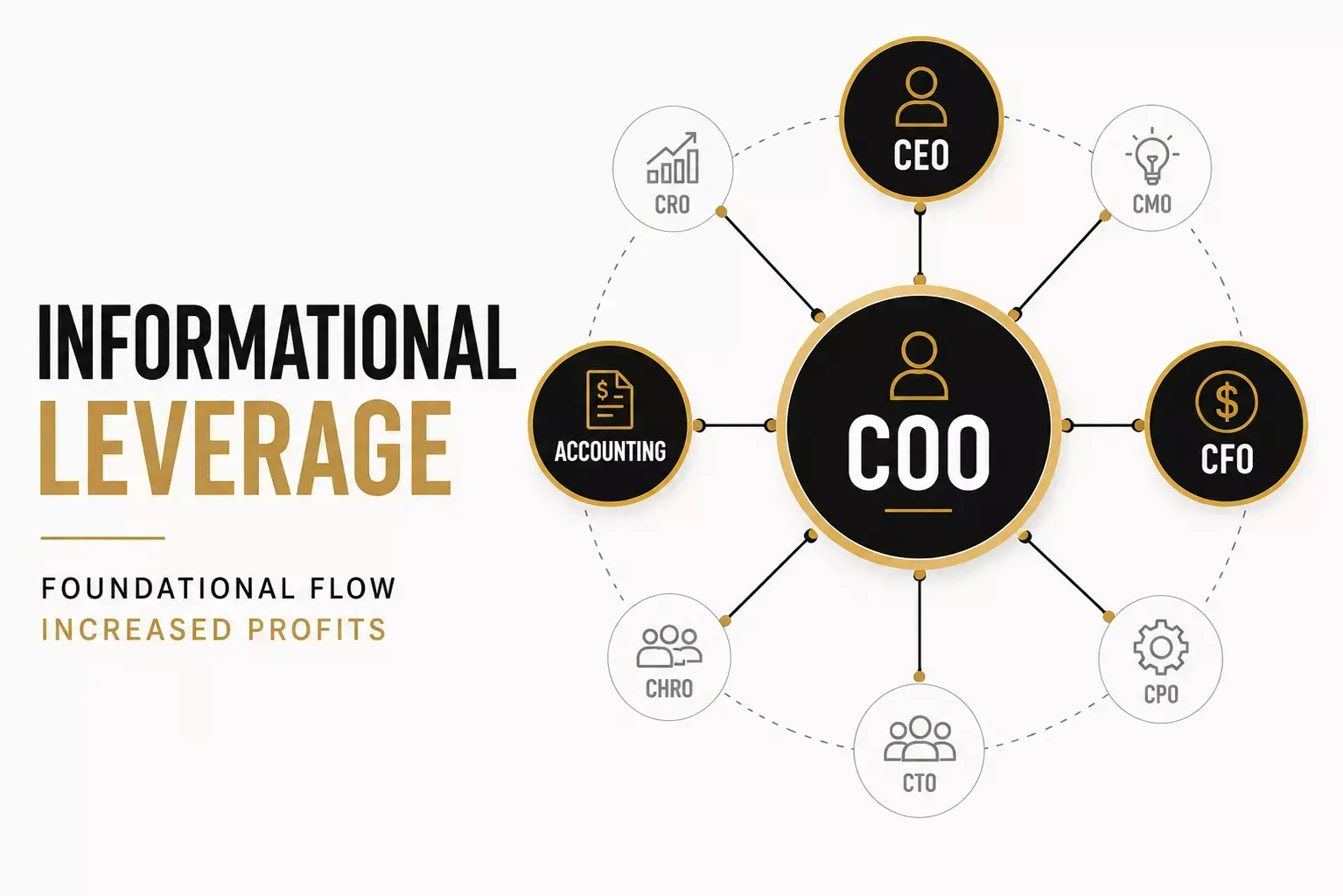
"Accounting is a stick in the mud." "I'm not really sure what a COO does all day." "The CFO just plays around with their little Excel sheets." You have probably heard one of those lines. You may have thought one yourself. They sound like harmless office humor. They actually point to something expensive. In most growing service businesses, nobody has ever defined how operations and accounting work together. The people who produce your financial reports sit outside the very decisions those reports are meant to inform. That gap costs you every single month, quietly, in profit that should have been there. Part 1 of a 5-part series on the COO and Accounting relationship