

Don't Let Your Revenue Get Tangled: Mastering Your Accounting for Multiple Streams of Income
As businesses mature, the temptation to diversify becomes irresistible. A consultant
may provide strategy sessions while selling downloadable guides. A fitness studio might offer in-person classes alongside virtual memberships and branded merchandise. Restaurants sometimes expand into packaged goods such as sauces or meal kits. While multiple streams of income provide valuable resilience against market volatility, they simultaneously create accounting complexity that can obscure profitability and drain resources.
Without a proper financial structure, diversification can become a liability masquerading as a strength. Entrepreneurs find themselves unable to answer fundamental questions: Which channel actually drives profit? Which consumes disproportionate operational overhead? Which deserves continued investment? These aren't academic concerns. They directly determine whether your business thrives or slowly strangles itself with unproductive complexity.
Without a proper financial structure, diversification can become a liability masquerading as a strength. Entrepreneurs find themselves unable to answer fundamental questions: Which channel actually drives profit? Which consumes disproportionate operational overhead? Which deserves continued investment? These aren't academic concerns. They directly determine whether your business thrives or slowly strangles itself with unproductive complexity.

The Hidden Cost of Poor Income Categorization
Many business owners overlook a critical distinction between revenue growth and profit visibility. A coaching business that expands into digital courses might celebrate new revenue, only to discover later that customer acquisition costs for the course channel exceed those for one-on-one services by 300 percent. Without tracking multiple streams of income separately, this inefficiency remains invisible until it's already consumed months of resources.
Payment processors compound this problem. Payment platforms often batch deposits from multiple sources into single transfers. Marketing expenses, software
subscriptions, and fulfillment charges blur together in expense accounts. The result: financial statements that show impressive top-line growth while actual profitability deteriorates undetected.
Expense allocation errors are particularly insidious. When a single advertising campaign drives sales across three revenue channels, business owners often make a false choice: assign the entire campaign cost to one channel, or divide it equally across all three. Both approaches distort reality, preventing accurate comparison of which channel actually generated the best return on that investment.
multiple income streams
Designing a Financial Architecture for Clarity
Sophisticated businesses separate income sources at the categorization level, not just in monthly reports. This means distinct income accounts for each revenue channel. Consulting fees, product sales, course revenue, subscription income, and affiliate earnings each occupy their own account.
This granular approach serves multiple purposes beyond simple tracking. It enables accurate gross margin analysis for each channel. A high-revenue offering might carry dramatically different profit margins than a lower-volume stream. Without this distinction, margin improvements in one area mask deterioration in another.
Monthly profit and loss statements should break down revenue, direct costs, and allocated overhead by channel. Direct costs attach to specific streams: fulfillment expenses for physical products, hosting for digital courses, or subcontractors for consulting projects. Allocated overhead requires more thoughtfulness. If you spend $3,000 monthly on business insurance that protects all operations equally, you might allocate proportionally to each channel based on revenue percentage.
This structured approach transforms accounting from a compliance burden into a strategic tool. Entrepreneurs can identify which channels justify expanded investment and which consume attention without generating proportional returns.
The Strategic Evaluation Framework for Multiple Streams of Income
Armed with accurate financial data, you can make informed decisions about which streams of income deserve continued development. Performance evaluation should consider not just revenue, but also:
- Growth trajectory
- Profit margins
- Scalability, and
- Alignment with your long-term vision
A channel generating consistent revenue with minimal oversight warrants different treatment than one requiring constant attention for modest returns. Similarly, high-margin offerings deserve different strategic prioritization than high-volume, low-margin streams.
Sometimes the best decision is discontinuation. Eliminating underperforming offerings frees resources, reduces administrative burden, and allows focus on your strongest opportunities.
Build Financial Clarity That Supports Growth
Whether you operate two revenue channels or ten, financial clarity remains non-negotiable. The complexity introduced by multiple streams of income isn't solved by working harder or hoping for better results. It's solved through intentional structure and consistent execution.
First Steps Financial
helps entrepreneurs strengthen their financial systems through fractional bookkeeping and financial consultation services designed for growing organizations. Clear reporting and organized accounting structures provide the insight needed to manage expanding revenue streams with confidence.
If you want greater clarity around your income channels and accounting structure, connect with us
to start building a system that supports your growth.
Our Latest Insight

Article 1 ended with a question. When does your COO actually talk to Accounting before a decision gets made? How long did it take you to answer? Immediately? Minutes? Maybe you could not think of a single example. Bills get paid, projects keep moving, and financial reports show up. Nothing feels obviously broken, so you conclude everything is fine. If that question made you uncomfortable, you are not alone. Here is the part that keeps this problem alive. You only know what good looks like based on what you have already lived through. Most owners have never worked inside a business where Operations and Accounting were intentionally built to function together. So they measure their company against their own status quo. This article gives you a different reference point. You will see what the relationship looks like day to day, what rhythm it runs on, and five things you can check this week. None of it requires scrapping what you have built. The people are already in the building. The data already exists. What changes is how the pieces are arranged, and how much leverage you get out of the company you have right now. Part 2 of a 5-part series on the COO-Accounting relationship
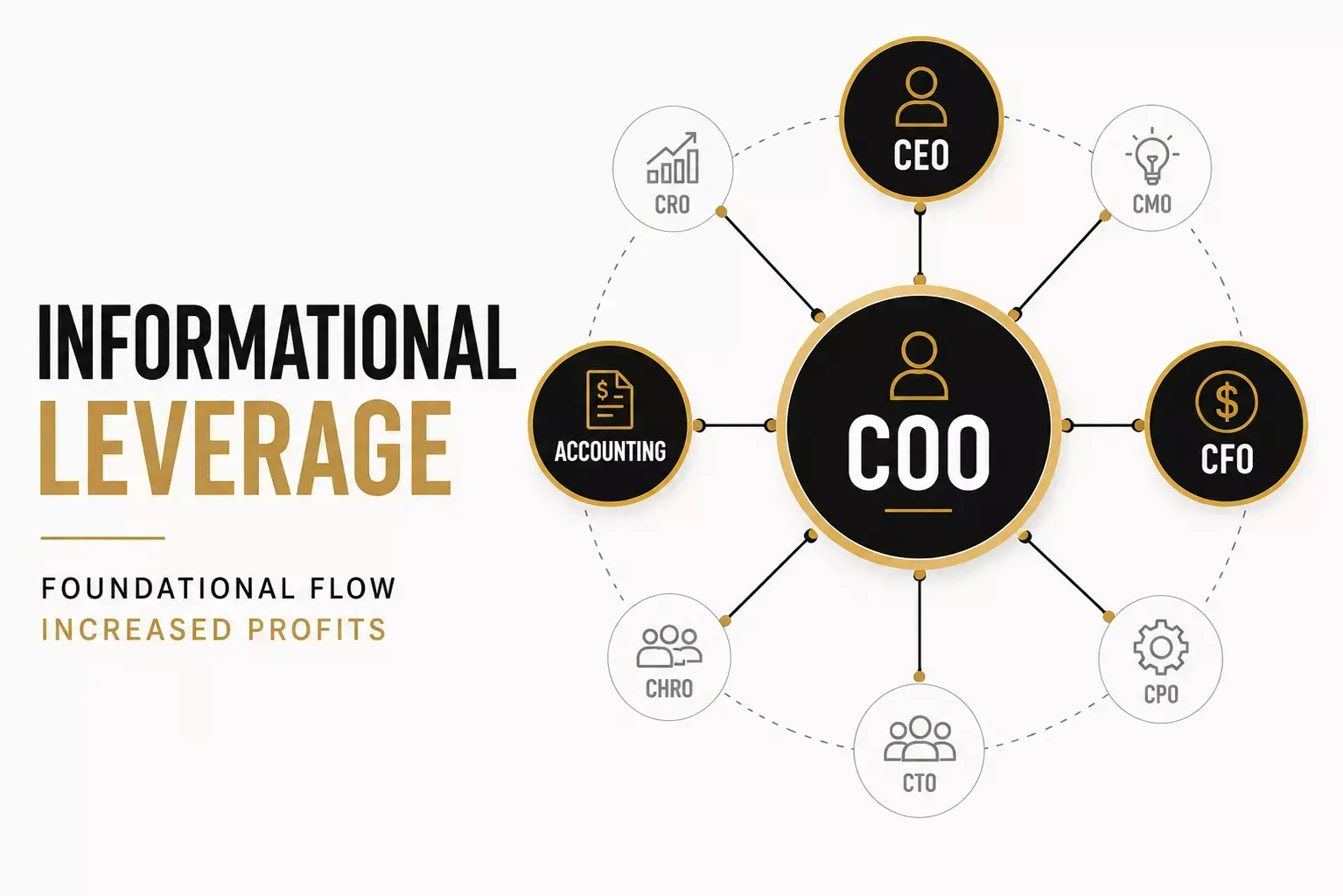
"Accounting is a stick in the mud." "I'm not really sure what a COO does all day." "The CFO just plays around with their little Excel sheets." You have probably heard one of those lines. You may have thought one yourself. They sound like harmless office humor. They actually point to something expensive. In most growing service businesses, nobody has ever defined how operations and accounting work together. The people who produce your financial reports sit outside the very decisions those reports are meant to inform. That gap costs you every single month, quietly, in profit that should have been there. Part 1 of a 5-part series on the COO and Accounting relationship

In modern business management, effective capacity planning requires far more than matching supply with demand—it demands a rigorous financial framework. Every unit of unused capacity represents sunk cost and margin erosion, while every unit of insufficient capacity risks churn and missed revenue. By evaluating capacity planning as a financial exercise, organizations can translate labor hours, utilization rates, and operational throughput into clear financial metrics like cost of goods sold (COGS) and return on invested capital (ROIC). This guide explores how to integrate operational capacity into your financial planning and analysis (FP&A) cycle to drive sustainable, cash-efficient scale.