

Monthly Financial Analysis Checklist: What Every Business Owner Should Analyze
Most business failures aren't caused by bad products or poor service. They result from preventable financial blindness. When leaders lose sight of their numbers, minor issues compound into critical problems. A disciplined approach to financial analysis transforms raw data into strategic advantage, turning monthly reviews into your organization's competitive edge. This systematic practice reveals patterns invisible to quarterly reviews, catches problems while they're still manageable, and positions your business to capitalize on emerging opportunities.

Financial Analysis: Reviewing Cash Flow for Liquidity
Cash flow statements
reveal the actual movement of money through your organization. Unlike profit and loss statements that may show theoretical gains, cash flow tracks real dollars available for operations. This distinction matters because a profitable business can still fail if it cannot meet immediate obligations like payroll or vendor payments.
Compare your operating cash inflows against the timing of revenue collection. Late-paying clients create gaps that strain operations, while unexpected expense spikes can drain reserves faster than anticipated. Identifying these patterns early allows you to secure lines of credit before emergencies arise or adjust payment terms proactively.
Revenue Trends and Profitability Metrics
Break down revenue by product line, service category, or funding source to understand what actually drives your business forward. This granular view exposes which offerings generate sustainable growth and which drain resources without adequate return.
Gross margin analysis measures how efficiently you convert sales into profit before operating expenses. A shrinking margin signals pricing pressure, rising production costs, or inefficient operations. Through consistent financial analysis, address margin erosion by adjusting:
- Pricing strategies to reflect true value delivery
- Vendor agreements to reduce input costs
- Operational processes to eliminate waste
Operating Expense Management
Track monthly spending against both budget projections and historical patterns. This dual perspective reveals whether cost increases represent intentional investments or uncontrolled drift. Categorize expenses by function (staffing, marketing, technology, facilities) to identify which areas deliver measurable returns and which consume resources without proportional benefit.
Rising costs aren't inherently problematic if they support strategic priorities. The key is ensuring every dollar spent advances your objectives. Technology investments should improve efficiency, marketing spend should generate qualified leads, and staffing increases should enable capacity growth.
Working Capital Cycle Analysis
Accounts receivable management determines how quickly customer promises convert to usable cash. Calculate your average collection period and track changes over time. Lengthening collection cycles indicate either deteriorating customer quality or inadequate follow-up processes.
Accounts payable
timing affects both cash preservation and vendor relationships. While extending payment terms preserves liquidity, consistently pushing limits damages partnerships and may result in unfavorable pricing or service priority. The optimal approach balances cash needs with relationship value.
Integrating both metrics reveals your working capital cycle efficiency. Faster collection combined with strategic payment timing creates self-sustaining operations that require less external financing.
Key Performance Indicators That Matter
Financial analysis extends beyond traditional accounting metrics to include operational indicators that predict future performance. Select KPIs that directly connect to your strategic objectives rather than tracking generic benchmarks. Essential metrics to monitor include:
- Customer acquisition cost
- Revenue per employee
- Gross profit margin
- Accounts receivable turnover
- Operating cash flow ratio
Growth-focused organizations emphasize expansion metrics like customer lifetime value and market penetration rates. Established businesses prioritize efficiency indicators such as operating leverage and return on invested capital. Nonprofits track donor retention and program efficiency ratios.
Building Sustainable Review Practices
Establish a consistent monthly schedule for financial analysis rather than sporadic deep dives. Use a standardized checklist covering cash flow, revenue composition, expense trends, working capital metrics, and relevant KPIs. This discipline converts periodic reporting into strategic management.
Regular reviews train your eye to spot anomalies quickly. You'll recognize when trends diverge from expectations and can investigate causes while course correction remains simple. Monthly attention prevents the accumulation of small issues into existential threats.
Creating Accountability Through Numbers
Financial analysis creates transparency around resource allocation decisions and performance outcomes. When leadership commits to regular review, the entire organization develops financial awareness that improves decision-making at every level.
This discipline prepares your business for both challenges and opportunities. Leaders who understand their financial position can move decisively when competitors hesitate. They weather downturns without panic and invest in growth from a position of strength.
Building this capability requires consistent effort, but the foundation it creates enables sustainable success. Need help streamlining your monthly financial analysis process? Our team at First Steps Financial is here to help. Let’s chat.
Our Latest Insight

Article 2 ended with a question. What would you actually see first if this relationship started breaking down inside your business? Here is the answer. You would see five things. If you are like most owners reading this, you are already looking at two or three of them. None of the five announces itself as a communication problem. Each one shows up as friction inside your accounting systems, wearing a perfectly reasonable disguise. That is the difficulty. On the surface, none of these looks like a broken relationship. Each looks like something else entirely. A busy month. A tough quarter. A personality difference between two people who were never going to be friends anyway. Every one of them gets explained away the first time you see it. That is exactly what makes them expensive. This article does not fix any of it. Article 4 does that. The job here is naming what is already sitting in front of you. Most owners walk past these signs for years without recognizing what they are looking at. Part 3 of a 5-part series on the COO-Accounting relationship

Article 1 ended with a question. When does your COO actually talk to Accounting before a decision gets made? How long did it take you to answer? Immediately? Minutes? Maybe you could not think of a single example. Bills get paid, projects keep moving, and financial reports show up. Nothing feels obviously broken, so you conclude everything is fine. If that question made you uncomfortable, you are not alone. Here is the part that keeps this problem alive. You only know what good looks like based on what you have already lived through. Most owners have never worked inside a business where Operations and Accounting were intentionally built to function together. So they measure their company against their own status quo. This article gives you a different reference point. You will see what the relationship looks like day to day, what rhythm it runs on, and five things you can check this week. None of it requires scrapping what you have built. The people are already in the building. The data already exists. What changes is how the pieces are arranged, and how much leverage you get out of the company you have right now. Part 2 of a 5-part series on the COO-Accounting relationship
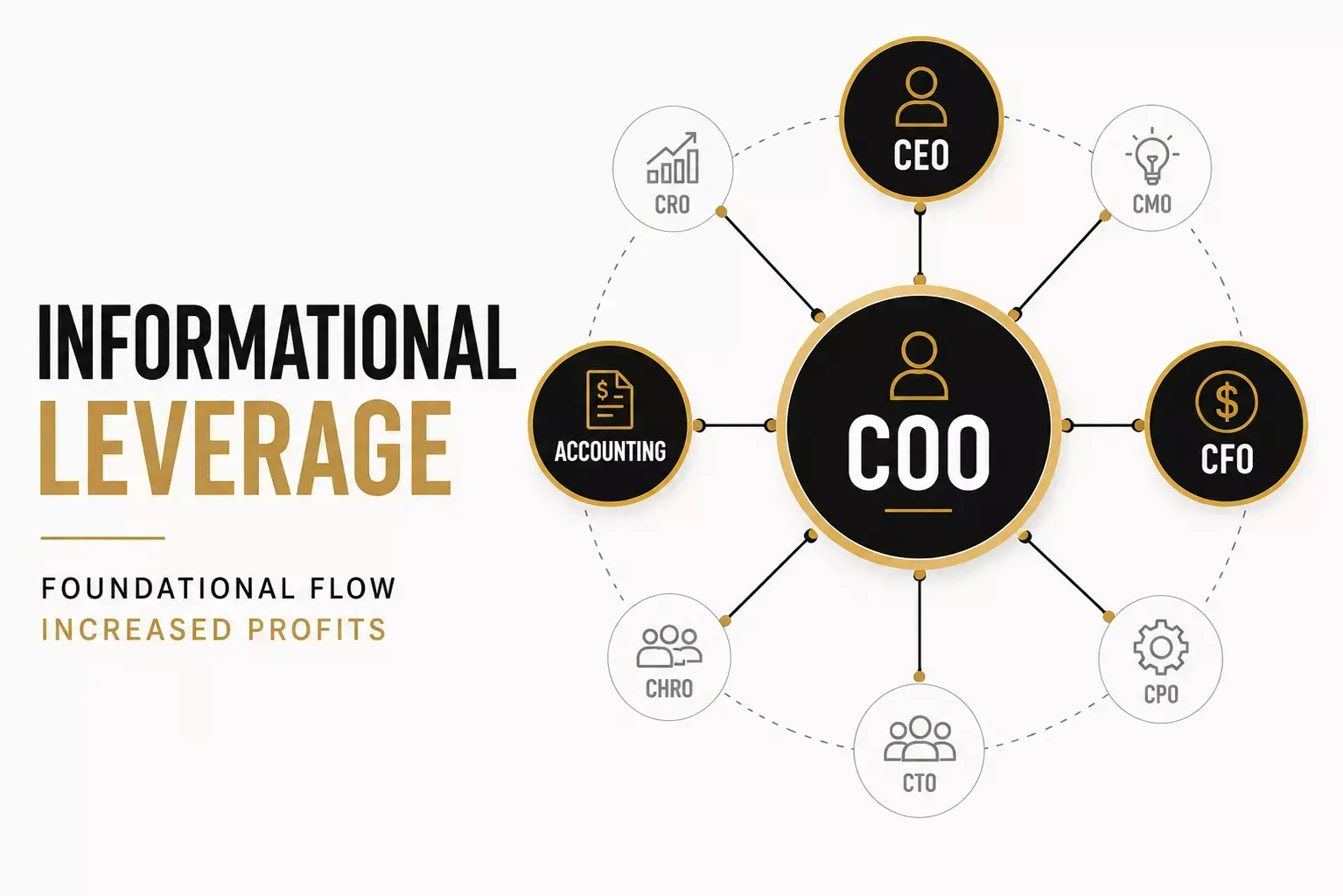
"Accounting is a stick in the mud." "I'm not really sure what a COO does all day." "The CFO just plays around with their little Excel sheets." You have probably heard one of those lines. You may have thought one yourself. They sound like harmless office humor. They actually point to something expensive. In most growing service businesses, nobody has ever defined how operations and accounting work together. The people who produce your financial reports sit outside the very decisions those reports are meant to inform. That gap costs you every single month, quietly, in profit that should have been there. Part 1 of a 5-part series on the COO and Accounting relationship